


Gato gPrecisionBuilt for Trust

    Gato gPrecision

    One platform for live risk, margin, and compliance. Plug it into your own stack instead of building it. See exposure across assets, desks, and regions in one view. Set limits, track results, and catch odd orders as they happen.

    Real-Time, Market-Aware Execution Risk and Margin
    Real-time risk dashboard
    At a Glance
    • 01

      Real-time pre-trade risk validation aligned with regulatory requirements (SEC 15c3-5)

    • 02

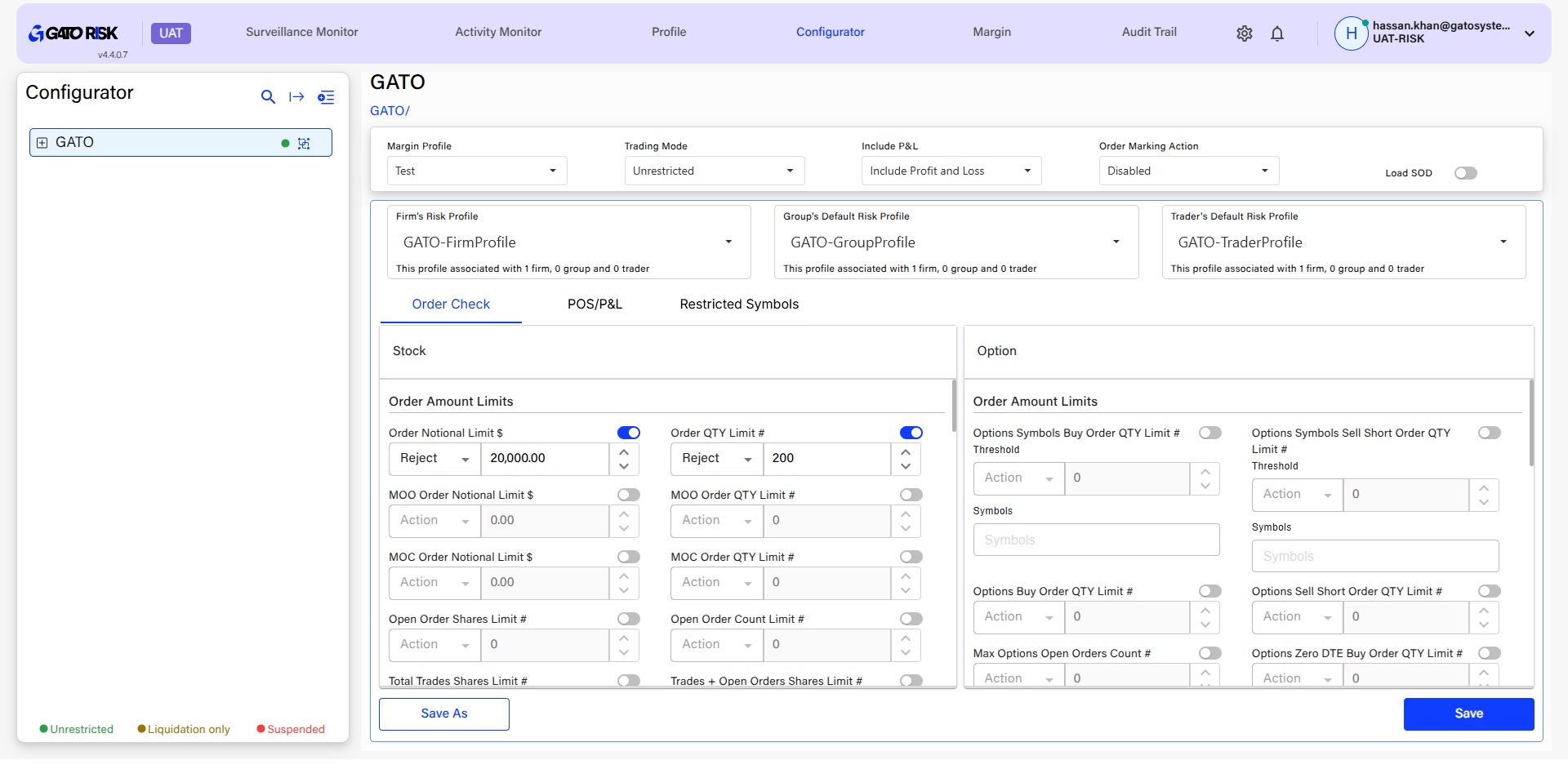
      Granular risk control through hierarchical profiles

    • 03

      Configurable Margin management

    • 04

      Centralized monitoring for orders and trade state

    • 05

      Real-time rejection alerts with detailed notifications

    • 06

      Complete audit trail for all changes and user activities

    • 07

      Improved compliance & transparency

    • 08

      Faster decision-making and reduced operational & financial risk

    Capabilities

    Real-Time & Ultra-Fast

    Risk decisions are made in real time, at the same speed as trading.

    • Ultra-low latency decisioning
    • Built for high-throughput electronic trading

    Real-Time Margin & Buying Power Control

    Accurate capital enforcement using live data.

    • Native Reg-T margin calculation
    • Precise Start-of-Day and intraday Buying Power

    Configurable Automated Risk Actions

    Immediate, rule-driven responses, fully controlled by Risk Managers.

    • Generate real-time alerts and warnings
    • Actions configured directly from the front end
    • Firm, desk, and trader level kill switch halts new order flow on breach

    Market-Aware Intelligence

    Risk adapts continuously to live market data.

    • Risk decisions evolve as the market moves
    • Controls respond instantly to changing market conditions

    Real-Time PnL & Loss Protection

    Loss limits that react instantly to market movement.

    • Continuous monitoring of realized and unrealized PnL
    • Unrealized PnL recalculated using live market prices

    Real-Time Visibility & Transparency

    Live insight into system behavior and trader risk.

    • Real-time visibility into orders, trades, and rejects
    • Designed for easy integration into existing dashboards and systems

    Advanced Price Discipline

    Smarter aggressive and passive price checks than traditional risk systems.

    • Robust price-deviation logic
    • Handles extreme price granularity correctly

    Exposure & Order Risk Controls

    Always-on protection against excessive risk.

    • Real-time position exposure checks
    • Continuous open order exposure monitoring
    Next step

    See gPrecision in action

    Walk through gPrecision with our team on a live environment using your workflows, venues, and reporting obligations.

    More in Risk & Compliance

    Continue exploring the family

    About gPrecision

    How firms use gPrecision

    gPrecision checks orders before they reach a venue. It reads live prices and current positions. It applies credit and capital limits, catches bad or duplicate orders, and enforces position, concentration, and restricted-list rules.

    SEC Rule 15c3-5 makes these checks part of the order path. A firm with market access must block orders that break its credit or capital limits. The firm must also control those limits itself, not the vendor and not the client.

    So limits need live prices and current positions on every order. Each check needs a saved record of what it saw. gPrecision runs inside the routing path, so no check reads an end-of-day file.

    • Credit and capital thresholds evaluated on every order before routing.
    • Erroneous-order, duplicate, and fat-finger detection against live prices.
    • Position, concentration, and restricted-list controls by desk and account.
    • Hierarchical limits: firm, desk, account, trader, and strategy.
    • Retained record of each evaluation for supervisory and audit review.

    SEC Rule 15c3-5 changed pre-trade risk. Watching orders after the fact is no longer enough. A firm with market access must stop orders that break its credit or capital limits. The firm must control those limits itself, not a vendor and not a client.

    So each order needs a live check. That check reads current prices and current positions. It also leaves a record of what it saw at the time.

    gPrecision runs inside the routing path. No check reads an end-of-day file. When you change a limit during the day, the next order uses the new value.

    Does gPrecision satisfy SEC Rule 15c3-5 requirements?

    It provides the pre-trade layer the rule asks for. Credit and capital limits, bad-order checks, duplicate checks, and restricted lists all run before execution. The firm sets and owns the limits.

    Every check is saved. The written compliance program stays yours, but the technology part is covered.

    What does 'market-aware' mean in practice?

    Limits are checked against live prices and current positions, not a static file. So a size or exposure check reflects what the order would really do right now.

    That matters most in fast markets, when static limits go wrong.

    How much latency do the checks add?

    Checks run inside the routing path, not as an outside call. Overhead is microseconds to a few milliseconds, depending on the setup. A separate risk service usually costs more time than the checks themselves.

    Can limits differ by desk, account, or strategy?

    Yes. Limits sit at firm, desk, account, trader, and strategy level. The tightest one wins. Changes take effect on the next order, not the next day.

    Can gPrecision protect flow routed through a third-party OMS?

    Yes, as long as that flow passes through gPrecision on the order path. Watching trades after they happen does not meet a pre-trade rule.

    So the integration point matters, and we set it during onboarding.

    What happens when a limit is breached?

    The order is rejected before it reaches the venue. The trader sees the reason right away. The event is saved with the limit, the value checked, and the price data used.

    Supervisors can review breaches by desk or by trader.