




Modernizing Clearing Technology: From Legacy Systems to API-First Platforms
How clearing firms and self-clearing broker-dealers are replacing legacy technology with modern, API-driven clearing platforms.
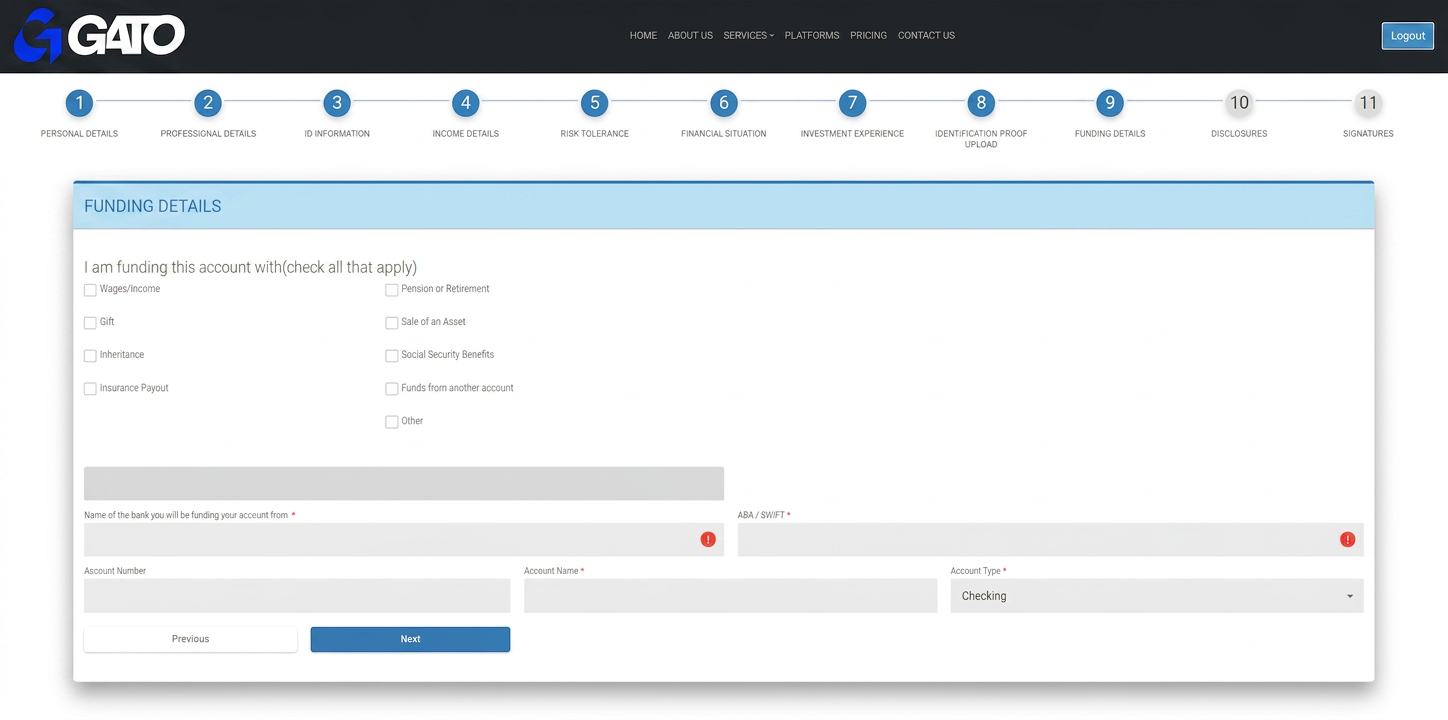
Automating fund movement and cash ops
Gato gView moves client funds without the manual steps. It handles approvals, sends the payment, and writes the report. All in one place.

Builds NACHA files after approval. Uploads them to the bank over secure SFTP. Writes the credit and debit GL entries too.
Logs what every user does. Export the audit report any time.
Sends pending transaction alerts to the right users. You set the timing and how often reminders repeat.
Connects to BMO over secure SFTP. Fund movements stay encrypted.
Builds NACHA files for ACH. Send them to the bank as-is.
Run it as a web app, as an API-only service, or as both.
Funds move faster. After the final approval, there are no manual steps.
Funding rules apply the same way every time. That cuts errors and exceptions.
Volumes can grow without adding staff. The work is automated.
Walk through gView with our team on a live environment using your workflows, venues, and reporting obligations.
Accelerate Onboarding With Confidence
Corporate Action System
The Central Hub For Institutional Transparency.
Turn Trading Activity Into Trusted Financial Outcomes
Self-Service Customer Portal for Brokerage Clients
Guides covering the regulations and workflows this module handles.
gView moves cash for you. It starts ACH and wire transfers, runs approvals, screens for risk, and matches every transfer to bank activity.
Cash movement is where risk meets service. A transfer held with no reason becomes a support call. A transfer sent with no check becomes a loss.
gView tests each request against your rules. It looks at speed, size, and account history. Anything outside policy goes to an approval queue. The decision is saved with it.
Settled items are matched back to bank records each day. So returns show up fast, not at month-end.
Cash movement is where risk meets service. A transfer held with no clear reason becomes a support call. A transfer sent with no check becomes a loss. Both come from one gap. The rules live in people's heads, not in the workflow.
gView applies your rules to every request. Anything outside policy goes to an approver. The call is saved. Settled items are matched to bank records.
Returns show up the next business day, not at month-end. Buying-power holds follow your own rules.
Rules are set once and used every time. Limits can differ by account age, funding history, account type, and past returns. New accounts get tight limits. Long-time clients are not slowed down.
Each request keeps its own record. You see the checks that ran. You see the limits, the approver, and the call. An auditor gets one screen.
Matching runs each day against bank and clearing records. Breaks show up the next morning. Each one links to the transfer. Staff work a short list, not a month.
ACH debits and credits, wires, internal journals, and checks. Each type has its own limits, cut-off times, and approval rules.
gView matches each return to the original transfer. It flags the account. It then applies your rules for buying power and withdrawals.
Each request is checked for speed, size, first use, and account history. Anything outside policy goes to a named approver. Every release, hold, and reject is saved with a reason and a name.
Yes. Settled items are matched to bank and clearing records each day. Anything that does not match shows up the next business day, not at month-end.
Yes. Limits can vary by account age, funding history, account type, and past returns. That is the usual way to cut first-time ACH risk. Long-time clients still move fast.
Yes. Cut-offs and same-day windows are set with the batch schedule. A late request is queued and shows its expected settlement date.
Each return is matched to the original transfer. The account is adjusted under your rules. The item lands in a queue with the reason code. Staff work it the next day.
Yes. In gPortal a client sees if a request is pending, in review, released, or settled. They also see the expected date. That alone cuts most transfer calls.
Gato modules work standalone or together — pick another family to continue.
One order book, one trading front end, and one link to global venues. Built for fast, institutional-grade execution.
Explore familyLive pre-trade risk checks plus CAT and CAIS reporting. Compliance grows with your volume, not against it.
Explore family