
Live pre-trade risk checks plus CAT and CAIS reporting. Compliance grows with your volume, not against it.
Real Time Risk & Regulator Ready Reporting
Compliance has two jobs: stop bad orders before they reach a venue, and prove later what happened.
SEC Rule 15c3-5 wants credit, capital, and fat-finger checks in the order path itself. CAT and CAIS then want those same events reported on time and linked to the right accounts.
 Built for Trust
Gato gPrecision
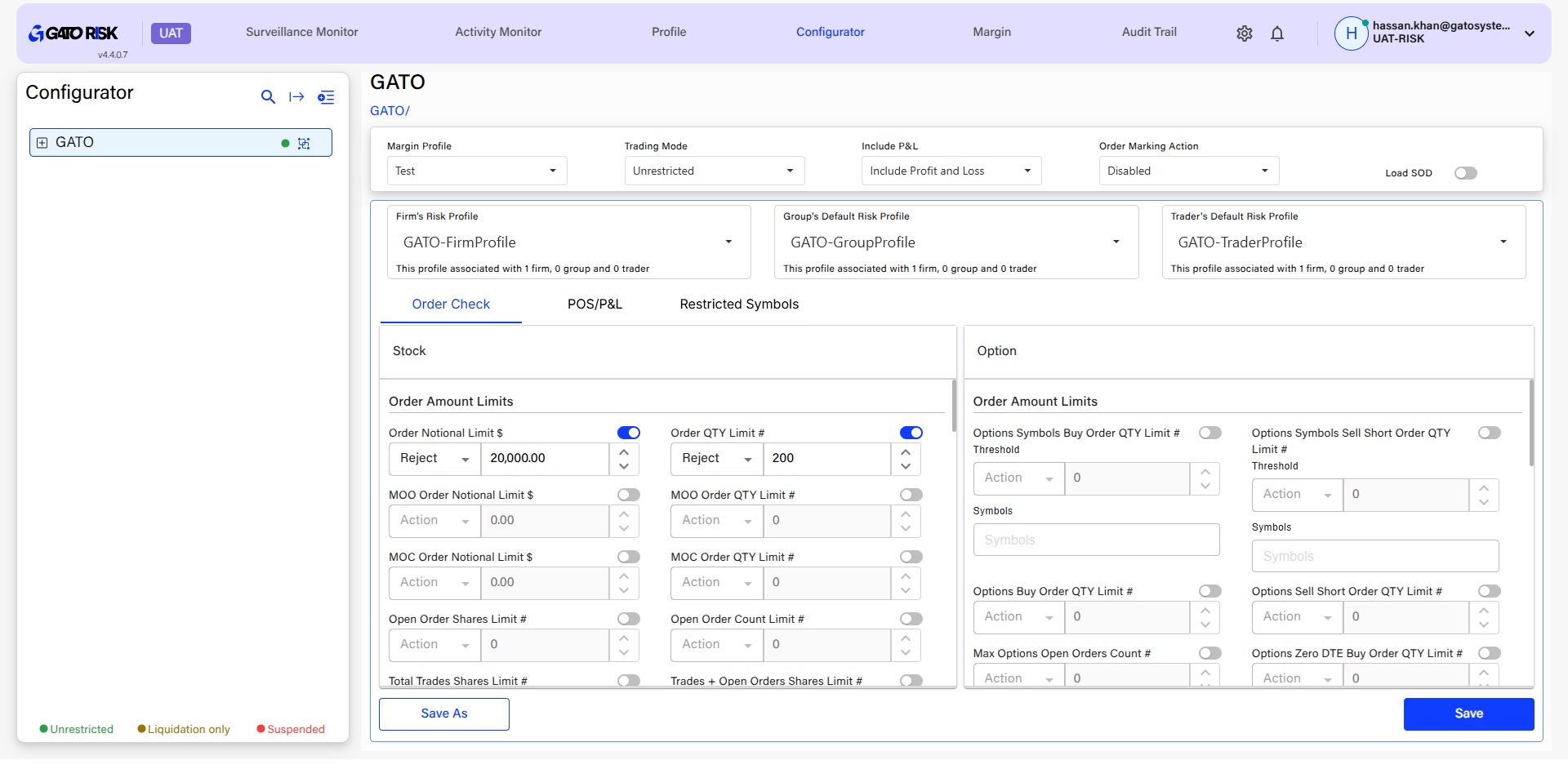
One platform for live risk, margin, and compliance. Plug it into your own stack instead of building it. See exposure across assets, desks, and regions in one view. Set limits, track results, and catch odd orders as they happen.
- 01
Real-time pre-trade risk validation aligned with regulatory requirements (SEC 15c3-5)
- 02
Granular risk control through hierarchical profiles
- 03
Configurable Margin management
- 04
Centralized monitoring for orders and trade state
- 05
Real-time rejection alerts with detailed notifications
- 06
Complete audit trail for all changes and user activities
- 07
Improved compliance & transparency
- 08
Faster decision-making and reduced operational & financial risk
Real-Time & Ultra-Fast
Risk decisions are made in real time, at the same speed as trading.
- Ultra-low latency decisioning
- Built for high-throughput electronic trading
Real-Time Margin & Buying Power Control
Accurate capital enforcement using live data.
- Native Reg-T margin calculation
- Precise Start-of-Day and intraday Buying Power
Configurable Automated Risk Actions
Immediate, rule-driven responses, fully controlled by Risk Managers.
- Generate real-time alerts and warnings
- Actions configured directly from the front end
- Firm, desk, and trader level kill switch halts new order flow on breach
Market-Aware Intelligence
Risk adapts continuously to live market data.
- Risk decisions evolve as the market moves
- Controls respond instantly to changing market conditions
Real-Time PnL & Loss Protection
Loss limits that react instantly to market movement.
- Continuous monitoring of realized and unrealized PnL
- Unrealized PnL recalculated using live market prices
Real-Time Visibility & Transparency
Live insight into system behavior and trader risk.
- Real-time visibility into orders, trades, and rejects
- Designed for easy integration into existing dashboards and systems
Advanced Price Discipline
Smarter aggressive and passive price checks than traditional risk systems.
- Robust price-deviation logic
- Handles extreme price granularity correctly
Exposure & Order Risk Controls
Always-on protection against excessive risk.
- Real-time position exposure checks
- Continuous open order exposure monitoring
 Your Reporting Handled. Your Burden Lifted.
Gato gReg
Built by industry veterans, Gato's CAT and CAIS solutions deliver unmatched accuracy, scalability, and confidence for broker-dealers and clearing firms.
Click on any image to zoom in
Precision Reporting. Zero Compromise Compliance.Gato CAT Reporting
Fully managed CAT reporting that automates capture, validation, enrichment, and submission across the full order lifecycle — purpose-built for high-volume broker-dealers.
- 01
Automated lifecycle reporting
- 02
Built-in validation controls
- 03
Massive-scale throughput
- 04
Full audit transparency
- 05
Continuous regulatory alignment
Massive Scale Processing
Handles extreme EOD bursts — 300M+ transactions in a single window for individual institutions.
Flexible Ingestion
EOD batch transformation of FIX logs, OMS exports, and custom files with hooks for real-time processing.
Precision Linkage
Stitches complex order lifecycles to ensure intra-firm and inter-firm linkage integrity.
Unified Transformation
Normalizes FIX 4.2/4.4, JSON, and CSV into the precise FINRA CAT Technical Specifications.
Rapid Remediation
Specialized teams resolve exceptions within the T+3 correction window.
Privacy-First Customer & Account ReportingGato CAIS Reporting
Centralize, validate, and submit customer and account data with precision — purpose-built for broker-dealers managing complex client structures under FINRA CAIS.
- 01
Accurate, timely submissions
- 02
Centralized data aggregation
- 03
Automated exception handling
- 04
Encrypted & secure
- 05
Audit-ready governance
Encrypted Data Vault
Sensitive identifiers (SSNs, TINs, EINs) stored encrypted; decrypted only in volatile memory.
Automated TID Generation
Transforms PII into Transformed Input IDs so raw identifiers never reach the CAT CAIS environment.
Large Trader ID Tracking
Automated LTID monitoring satisfies SEC Rule 13h-1 within the CAIS framework.
Data Integrity Scrubbing
Pre-submission checks identify mismatched profiles and missing mandatory fields.
Audit-Ready Logging
Immutable log of every transformation and submission for FINRA inquiries.
See Risk & Compliance in action
Walk through the Risk & Compliance modules with our team on a live environment using your own workflows, venues, and reporting obligations.
Risk & Compliance Questions
SEC Rule 15c3-5 requires risk controls in the order path and under the broker-dealer's own control, not in a report produced after the close. CAT and CAIS then require the same order and account events to be reported completely, on time, and linked to the right customer records. Firms that solve those separately spend most of their compliance budget reconciling the two.
gPrecision evaluates credit, capital, erroneous-order, duplicate, and restricted-list checks inline against live prices and positions, and gReg builds CAT and CAIS submissions from those same events. The result is one lineage from order entry to regulatory submission, which is the level of detail examiners ask for when they pick a single order apart.
Controls are set by limit, not by code change. Firm, desk, account, trader, and strategy each carry their own thresholds. A change is a setting, and the setting keeps a history of who changed it and when.
Checks run on live data. Prices, positions, and buying power come from the same records the blotter reads. Nothing waits for an end-of-day file.
Reporting starts at the source. Order and account events become reportable events as they happen, so the file you submit matches what the desk actually did.
Repairs are tracked, not chased. Feedback from CAT and CAIS lands in a queue with the original event attached. An analyst sees the reason, the fix, and the resubmission in one place.
Third-party flow is welcome. Orders and executions from an outside OMS, EMS, or clearing platform are normalised against the same reference data and reported next to your own flow.
Exam preparation stops being a project. Every control that touched an order, the values in force, the route that followed, and the reported events stay together for the retention period.
Supervision benefits too. Alerts, overrides, and approvals sit beside the order they relate to, so a reviewer reads one story rather than four exports.
Can limits be changed during the trading day?
Yes. Authorised users adjust thresholds while the market is open, and the change takes effect on the next order. The old value, the new value, the user, and the timestamp are all recorded.
What happens when a control blocks an order?
The order is stopped before it leaves the firm, the trader sees the reason, and the event is logged with the values that caused it.
Supervisors can review or release it under their own permissions.
How are late or rejected filings handled?
Rejections and warnings return to a repair queue with the underlying event attached. Analysts correct the data at the source and resubmit, and the platform tracks the correction against the original deadline.
Are pre-trade risk checks applied before the order leaves the firm?
Yes. Credit and capital thresholds, order-size and price-collar checks, duplicate and fat-finger detection, and restricted-list screening are evaluated inline on the order path before routing, using live market data rather than end-of-day snapshots.
How are CAT and CAIS submissions generated?
From the order, execution, and account events already captured by the platform.
Reportable events are built at the source, validated against current CAT technical specifications, submitted on the required schedule, and tracked through feedback and repair so late corrections are the exception.
Can reporting cover flow that originates in third-party systems?
Yes. gReg ingests order and execution data from external OMS, EMS, and clearing platforms, normalises it against the same reference data, and reports it alongside flow that originated in Gato modules.
What does an examiner-ready audit trail include?
Every control that evaluated an order, the parameter values in force at that moment, who changed them and when, the routing decision that followed, and the reportable events derived from it — retained together so a single order can be reconstructed end to end.
Explore the rest of the suite
Gato modules work standalone or together — pick another family to continue.
Trading & Execution
One order book, one trading front end, and one link to global venues. Built for fast, institutional-grade execution.
Explore familyOperations & Data
Digital onboarding, corporate actions, reporting, and client self-service. One workflow layer that keeps the back office moving.
Explore family